
Open post

Which Presents the Greatest Challenge for Commercial Property Owners?

  1. A) EPC Compliance
  2. B) Energy Costs
  3. C) Future Investment Requirements
  4. D) Asset Performance

Ask a room full of commercial property owners this question and the answer will often depend on their immediate priorities.

A landlord facing an expiring lease may be focused on EPC compliance. An occupier with rising utility bills may be more concerned about energy costs. An investor reviewing a portfolio may be thinking about future capital expenditure, whilst an asset manager may be focused on maintaining performance and occupancy levels.

The reality is that all four challenges are closely connected.

EPC Compliance

For many years, compliance has been the primary driver behind EPC assessments. Property owners need to understand whether their buildings meet current regulatory requirements and whether any action is required to maintain compliance.

Whilst compliance remains important, focusing solely on obtaining a certificate can sometimes result in a missed opportunity. An EPC should not simply be viewed as a regulatory document but as a source of information about how a building performs and where improvements may be possible.

The challenge is that compliance tells you whether a property meets today’s requirements, but it does not necessarily help you prepare for tomorrow’s.

Energy Costs

Energy costs remain a significant concern for both landlords and occupiers.

Poorly performing buildings often consume more energy, increasing operational costs and potentially making properties less attractive to tenants. As businesses become increasingly focused on efficiency and sustainability, energy performance is becoming a more important consideration in leasing and occupation decisions.

Understanding how a building performs can help identify opportunities to reduce consumption, improve efficiency and support both operational and environmental objectives.

Future Investment Requirements

For many property owners, this is often the greatest unknown.

Questions frequently include:

  • Which assets are most likely to require future investment?
  • How much could future compliance improvements cost?
  • Which properties should be prioritised?
  • Can improvements be phased over time?

Without a clear understanding of current performance and risk, it can be difficult to make informed investment decisions.

This is particularly relevant for portfolios comprising properties of different ages, construction types and uses, where improvement requirements can vary significantly from one asset to another.

Asset Performance

Ultimately, asset performance sits at the centre of the discussion.

A well-performing asset is more likely to:

  • Attract and retain occupiers.
  • Support long-term value.
  • Reduce compliance risk.
  • Improve energy efficiency.
  • Require less reactive investment.

Understanding asset performance allows property owners to make informed decisions rather than responding to issues as they arise.

So Which Is the Greatest Challenge?

For most property owners, the answer is not any single issue in isolation.

The greatest challenge is understanding how these factors interact.

EPC compliance, energy costs, future investment requirements and asset performance are all connected. Decisions made today can influence compliance obligations, operating costs and investment requirements for years to come.

This is why many organisations are moving beyond simple compliance assessments and adopting a more strategic approach to understanding their property assets.

Beyond Compliance

A standard EPC provides an important starting point, but it only tells part of the story.

Property owners increasingly need insight that helps them understand:

  • Current compliance position.
  • Future compliance risks.
  • Energy performance opportunities.
  • Investment priorities.
  • Long-term asset resilience.

This is where Property Energy Intelligence™ provides value.

By transforming compliance data into practical commercial insight, property owners can make better-informed decisions, prioritise investment effectively and develop strategies that support the long-term performance of their property portfolios.

The Question to Ask

Perhaps the real question is not which challenge is greatest today, but whether you have the information needed to manage all four effectively tomorrow.

About the Author

This article was written by the team at Ener-Services & Surveys Ltd , specialists in Commercial EPCs, Property Energy Intelligence Reports™ and Portfolio Compliance Reviews. With more than 10 years’ experience and over 4,000 commercial properties assessed, we help property owners, investors, occupiers and asset managers understand compliance obligations, identify future risks and make informed decisions about the performance of their property assets.

Our work ranges from individual Commercial EPC assessments through to large-scale portfolio compliance and investment reviews covering industrial estates, listed building portfolios, local authority estates and multi-property investment portfolios throughout the UK.

Need Advice on Your Portfolio?

Whether you require a Commercial EPC, a Property Energy Intelligence Report™ or a Portfolio Compliance Review, our team can help you move beyond compliance and gain a clearer understanding of your property’s current position, future obligations and improvement opportunities.

Experience. Insight. Reliability.

Contact us today to discuss your requirements at office@ener-services.co.uk or on 01253 486 919.

Author: Neil Austin
Managing Director
Ener-Services & Surveys Ltd

“Neil has spent more than a decade advising property owners, investors and organisations on Commercial EPC compliance, energy performance and portfolio risk management. Having overseen thousands of commercial property assessments, he specialises in helping clients understand future compliance obligations and develop practical strategies for improving asset performance.”

 

Open post

Property Energy Intelligence™ – Turning Compliance Data into Commercial Insight

Property Energy Intelligence™ – Turning Compliance Data into Commercial Insight
Compliance data becomes significantly more valuable when it is used to support business decisions.
A Property Energy Intelligence Report™ goes beyond the information contained within a standard EPC and helps property owners understand:
• Asset-level risks
• Future compliance considerations
• Improvement opportunities
• Investment priorities
• Portfolio performance trends
Rather than simply identifying whether a property complies today, Property Energy Intelligence helps owners understand future obligations and opportunities.
For many organisations, this additional insight supports better investment planning, more effective asset management and improved portfolio resilience.
As energy performance requirements continue to evolve, understanding the intelligence behind the certificate is becoming just as important as the certificate itself.

About the Author
This article was written by the team at Ener-Services & Surveys Ltd , specialists in Commercial EPCs, Property Energy Intelligence Reports™ and Portfolio Compliance Reviews. With more than 10 years’ experience and over 4,000 commercial properties assessed, we help property owners, investors, occupiers and asset managers understand compliance obligations, identify future risks and make informed decisions about the performance of their property assets.
Our work ranges from individual Commercial EPC assessments through to large-scale portfolio compliance and investment reviews covering industrial estates, listed building portfolios, local authority estates and multi-property investment portfolios throughout the UK.
Need Advice on Your Portfolio?
Whether you require a Commercial EPC, a Property Energy Intelligence Report™ or a Portfolio Compliance Review, our team can help you move beyond compliance and gain a clearer understanding of your property’s current position, future obligations and improvement opportunities.
Experience. Insight. Reliability.
Contact us today to discuss your requirements at office@ener-services.co.uk or on 01253 486 919.

Author: Neil Austin
Managing Director
Ener-Services & Surveys Ltd

“Neil has spent more than a decade advising property owners, investors and organisations on Commercial EPC compliance, energy performance and portfolio risk management. Having overseen thousands of commercial property assessments, he specialises in helping clients understand future compliance obligations and develop practical strategies for improving asset performance.”

Open post

What is a Portfolio Compliance Review?

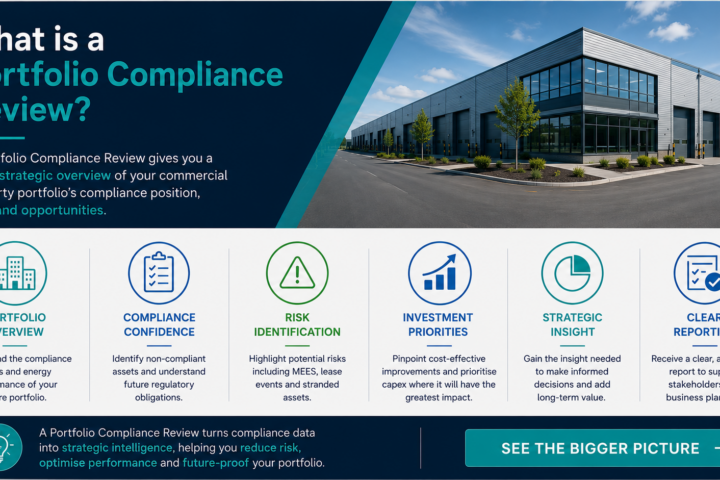
A Portfolio Compliance Review provides property owners with a clear understanding of the EPC and compliance position across their estate.
Many portfolios contain properties of differing ages, construction methods and uses. As a result, compliance obligations can vary significantly from one asset to another.
A Portfolio Compliance Review typically includes:
• EPC Assessment and Registration
• Compliance Schedule
• EPC Expiry Register
• Traffic Light Risk Matrix
• Executive Summary Report
The review enables property owners to identify which properties require immediate attention, which assets present higher compliance risks and where future action may be required.
For organisations managing multiple commercial properties, a Portfolio Compliance Review provides the foundation for effective compliance management.

About the Author
This article was written by the team at Ener-Services & Surveys Ltd , specialists in Commercial EPCs, Property Energy Intelligence Reports™ and Portfolio Compliance Reviews. With more than 10 years’ experience and over 4,000 commercial properties assessed, we help property owners, investors, occupiers and asset managers understand compliance obligations, identify future risks and make informed decisions about the performance of their property assets.
Our work ranges from individual Commercial EPC assessments through to large-scale portfolio compliance and investment reviews covering industrial estates, listed building portfolios, local authority estates and multi-property investment portfolios throughout the UK.
Need Advice on Your Portfolio?
Whether you require a Commercial EPC, a Property Energy Intelligence Report™ or a Portfolio Compliance Review, our team can help you move beyond compliance and gain a clearer understanding of your property’s current position, future obligations and improvement opportunities.
Experience. Insight. Reliability.
Contact us today to discuss your requirements at office@ener-services.co.uk or on 01253 486 919.

Author: Neil Austin
Managing Director
Ener-Services & Surveys Ltd
“Neil has spent more than a decade advising property owners, investors and organisations on Commercial EPC compliance, energy performance and portfolio risk management. Having overseen thousands of commercial property assessments, he specialises in helping clients understand future compliance obligations and develop practical strategies for improving asset performance.”

Open post

Why Commercial Property Owners Need More Than an EPC

For many years, Energy Performance Certificates (EPCs) have been viewed as a compliance requirement. Whilst EPCs remain essential, they only provide a snapshot of a building's energy performance at a specific point in time.

Commercial property owners increasingly face challenges relating to future compliance, investment planning, asset performance and sustainability objectives. Understanding whether a property currently meets minimum requirements is only part of the picture.

Property owners need to understand:

  • Future compliance risks
  • Potential investment requirements
  • Opportunities to improve energy performance
  • The impact of EPC ratings on asset value
  • Long-term portfolio resilience

This is why many organisations are moving beyond simple compliance and adopting a Property Energy Intelligence approach that transforms EPC data into practical commercial insight.

A standard EPC tells you where your property is today. Property Energy Intelligence helps you understand where it needs to go tomorrow.

About the Author

This article was written by the team at Ener-Services & Surveys Ltd , specialists in Commercial EPCs, Property Energy Intelligence Reports™ and Portfolio Compliance Reviews. With more than 10 years' experience and over 4,000 commercial properties assessed, we help property owners, investors, occupiers and asset managers understand compliance obligations, identify future risks and make informed decisions about the performance of their property assets.

Our work ranges from individual Commercial EPC assessments through to large-scale portfolio compliance and investment reviews covering industrial estates, listed building portfolios, local authority estates and multi-property investment portfolios throughout the UK.

Need Advice on Your Portfolio?

Whether you require a Commercial EPC, a Property Energy Intelligence Report™ or a Portfolio Compliance Review, our team can help you move beyond compliance and gain a clearer understanding of your property's current position, future obligations and improvement opportunities.

Experience. Insight. Reliability.

Contact us today to discuss your requirements at office@ener-services.co.uk or on 01253 486 919.

Author: Neil Austin
Managing Director
Ener-Services & Surveys Ltd

"Neil has spent more than a decade advising property owners, investors and organisations on Commercial EPC compliance, energy performance and portfolio risk management. Having overseen thousands of commercial property assessments, he specialises in helping clients understand future compliance obligations and develop practical strategies for improving asset performance."

Open post

16th Century Listed Building Estate

Project Overview

Brougham Hall is a remarkable Grade II* listed medieval estate with a history spanning centuries. Home to 21 artisan workshops, studios and craft businesses, the estate underwent a significant transition in 2024 when ownership and stewardship transferred from a charitable trust to a Community Interest Company formed by the tenant businesses themselves.

The new management team required specialist advice to understand their obligations regarding Commercial EPCs, Minimum Energy Efficiency Standards (MEES) and the unique considerations associated with listed and heritage properties.

The Challenge

There is a common misunderstanding that listed buildings are automatically exempt from the requirement to obtain an Energy Performance Certificate (EPC). In reality, listed properties and buildings located within conservation areas are not necessarily exempt, and property owners must understand whether an EPC is required for their specific circumstances.

Where a listed non-domestic property requires an EPC, it will also fall within the scope of the Minimum Energy Efficiency Standards (MEES) Regulations. Balancing compliance requirements with the protection of historic fabric and architectural significance presented a complex challenge for the estate.

The project involved assessing 21 occupied commercial units of varying ages, construction methods and uses, whilst carefully considering the limitations imposed by the building’s heritage status.

Our Approach

We undertook a comprehensive Commercial EPC and heritage compliance review across the estate. Detailed measured surveys were completed for each unit, including assessment of:

  • Building use and occupancy
  • Historic construction methods and materials
  • Windows, doors and glazing specifications
  • Heating and conditioning systems
  • Lighting installations
  • Energy performance characteristics

Our assessment process was entirely non-invasive, ensuring no damage or disruption to the historic fabric of the buildings.

Alongside the EPC assessments, we provided specialist guidance regarding listed building considerations, conservation requirements and potential pathways towards MEES compliance where improvements could be implemented without adversely affecting the character or appearance of the estate.

The Outcome

The project provided the Community Interest Company and its tenant businesses with a clear understanding of their Commercial EPC obligations, compliance position and future energy performance considerations.

Through detailed assessment and specialist reporting, the client gained the information needed to make informed decisions regarding energy performance improvements, future investment planning and compliance management, whilst preserving the historic character and significance of one of Cumbria’s most important heritage estates.

The result was a practical and balanced strategy that recognised both the regulatory requirements of modern commercial property management and the unique challenges associated with managing a Grade II* listed historic estate.

Open post

Industrial Estate Portfolio Compliance Review

The Challenge

This project involved two industrial estates comprising 63 tenanted units within a former aircraft manufacturing facility originally constructed during the Second World War. The combined estates extended to over 80,000 square metres and represented a diverse range of industrial and commercial accommodation.

Having benefited from limited investment under previous ownership, many of the properties presented significant energy performance challenges. The new owners faced the considerable task of understanding the compliance status of the portfolio and developing a practical strategy to address future energy performance requirements whilst balancing investment priorities and tenant considerations.

Our Approach

We undertook a comprehensive review of the portfolio, carrying out EPC assessments across the estates and providing detailed reporting on asset performance, compliance risks and improvement opportunities. Our enhanced reporting enabled the client to identify priority assets, understand future compliance considerations and develop a phased improvement strategy.

The Outcome

Following completion of the EPC programme and review process, all 60+ units achieved ratings above the minimum MEES requirements, providing the client with confidence that the portfolio met current compliance standards. The assessments and reporting enabled the new owners to clearly understand the condition and performance of their assets, identify future investment priorities and establish a structured approach to ongoing energy performance improvements across the estates.

By achieving compliance across the entire portfolio, the client protected rental income, reduced future compliance risk and created a foundation for long-term asset enhancement and value preservation.

Open post

Local Authority Estate MEES Compliance Programme

Local Authority Estate MEES Compliance Programme

Project Overview

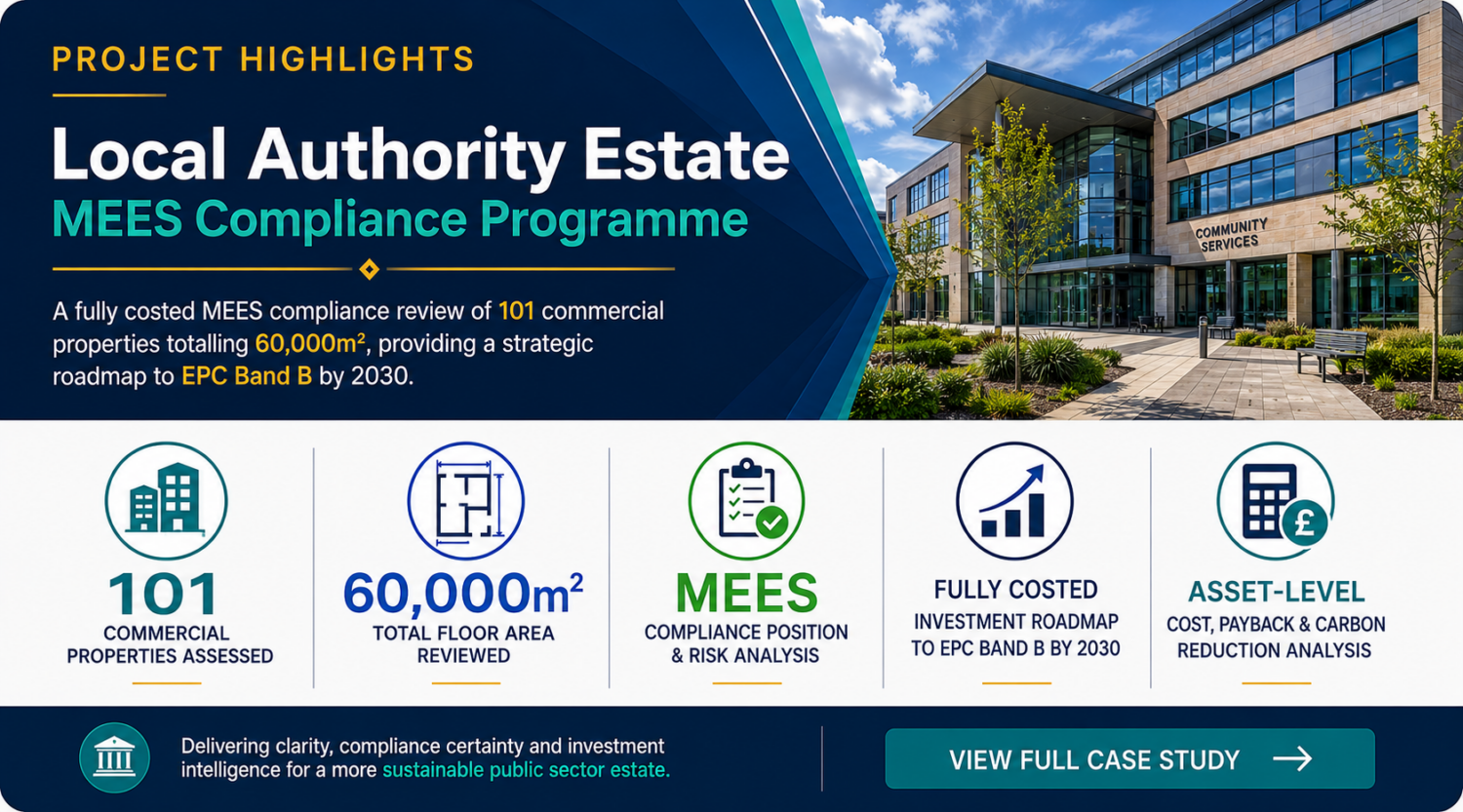
This strategic portfolio review involved a local authority estate comprising 101 commercial properties extending to approximately 60,000 square metres. The authority required a clear understanding of its existing compliance position against future Minimum Energy Efficiency Standards (MEES) targets, which at the time included an aspiration to achieve a minimum EPC Band B across the estate by 2030.

The project was designed to provide senior asset managers and decision-makers with a fully costed roadmap for future investment, enabling long-term budgeting and prioritisation of energy performance improvements across the portfolio.

The Challenge

Managing a large and diverse public sector property portfolio presents significant challenges when planning for future MEES compliance. Whilst individual Energy Performance Certificates provide a snapshot of current performance, they do not provide the detailed investment intelligence required to understand future liabilities, improvement opportunities and funding requirements.

The authority required a comprehensive assessment of all 101 assets to establish:

  • Current EPC and MEES compliance status
  • Future compliance risks
  • Potential improvement measures
  • Estimated capital investment requirements
  • Energy and carbon reduction opportunities
  • Timescales for implementation
  • Potential exemption positions under MEES regulations

Our Approach

We undertook detailed Commercial EPC assessments and Asset Energy Reviews across the entire estate. Each property was surveyed and modelled individually using SBEM, allowing us to evaluate building performance, identify improvement opportunities and assess multiple compliance scenarios.

For every asset, we produced detailed Property Energy Intelligence reporting that included:

  • Current EPC rating and energy performance profile
  • Future compliance assessment
  • Asset-specific improvement recommendations
  • Capital cost estimates
  • Discounted payback calculations
  • Seven-year payback assessments
  • Carbon reduction projections
  • EPC improvement pathways
  • Potential MEES exemption analysis
  • Indicative implementation priorities

This approach enabled the authority to move beyond simple compliance reporting and develop a strategic understanding of future investment requirements across the entire estate.

The Outcome

The project delivered a fully costed estate-wide compliance strategy, providing the authority with a clear roadmap towards future MEES targets and improved energy performance.

By combining Commercial EPC assessments with detailed asset-level investment modelling, the authority gained the information required to plan future capital expenditure, prioritise improvement programmes and manage compliance risk across 101 commercial properties.

The resulting portfolio intelligence enabled informed decision-making, supported long-term budget planning and established a practical framework for achieving future energy performance objectives whilst maintaining effective stewardship of public assets.

Scroll to top